How to Build a Gravity Gabion Retaining Wall That Lasts 50 Years
Last Updated: May 14, 2026
If you’re reading this, you’re probably about to build a gabion wall — or you’ve seen one fail and want to understand why. This guide covers everything you need: how gravity gabion walls actually work, which mistakes cause most failures, what materials actually matter, and how to build one that holds for decades without costly repairs.
What Is a Gravity Gabion Wall — and Why Does It Work?
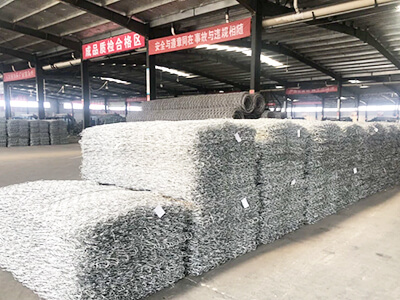
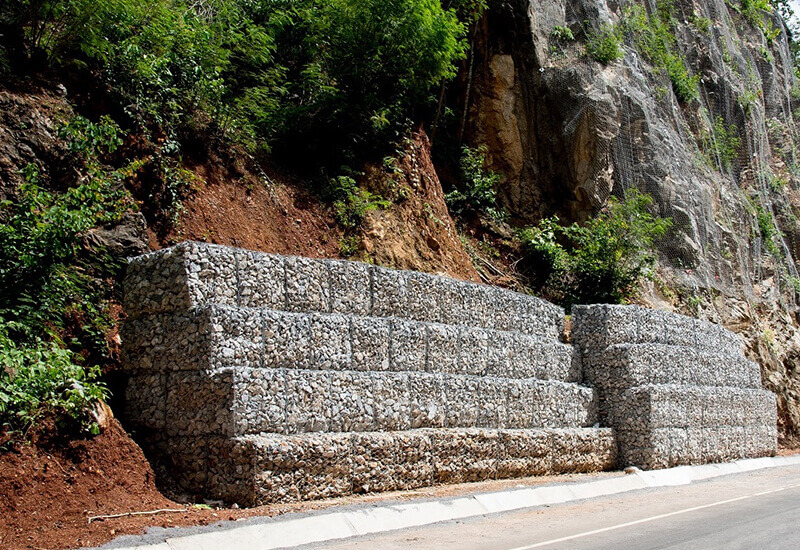
A gravity gabion retaining wall uses its own mass to resist lateral soil pressure — no concrete footings, no rebar cages. Wire mesh baskets are filled with hard, angular stone and stacked in courses. The stone fill is permeable (void ratio 30–40%), allowing water to drain freely through the wall structure, which eliminates the hydrostatic pressure buildup behind the wall that causes most rigid concrete retaining walls to fail.
The engineering principle is straightforward:
- Wall weight × base friction = sliding resistance
- Wall weight × lever arm = overturning resistance
Gabion walls are structurally distinct from reinforced gabion walls, which use geogrid strips or anchors to tie the wall to the soil mass behind it. This guide covers gravity walls only.
Before You Start — Do You Need an Engineer?
Every retaining wall project carries real structural responsibility. Get it wrong and the consequences range from permit issues to catastrophic failure. Use these thresholds to assess whether your project is within standard specification range — or whether it requires professional engineering input before proceeding.
- Walls up to 3 ft (≈1 m) in typical soils: generally within standard specification range for experienced contractors.
- Walls above 4 ft (≈1.2 m): typically require structural engineering and a building permit in most US jurisdictions.
- Engage a geotechnical or structural engineer before proceeding if: the site has poor bearing soil, is near a slope or cliff, is in a seismic zone, or drains onto the wall from above.
Gabion Wall Selection Checklist
| Situation | Recommendation | Warning |
| Wall height under 3 ft, good soil | Standard gravity gabion, self-build OK | Still needs drainage |
| Wall height 3–6 ft | Engineer required in most jurisdictions | Check local permit rules |
| Soft, clayey, or variable soil | Remove to competent material + deeper foundation | Do not build on fill |
| Slope above wall drains toward wall | Must include full drainage system | Risk of washout without it |
| Freeze-thaw climate | Hard rock only (no limestone), full drainage | Limestone spalls in freeze cycles |
| Near structure or property line | Engage engineer before procurement | Wall surcharge on existing foundations |
| Site inaccessible to machinery | Budget for manual rock handling | Cost can double vs. machine-accessible sites |
The 3 Things That Can Bring a Wall Down
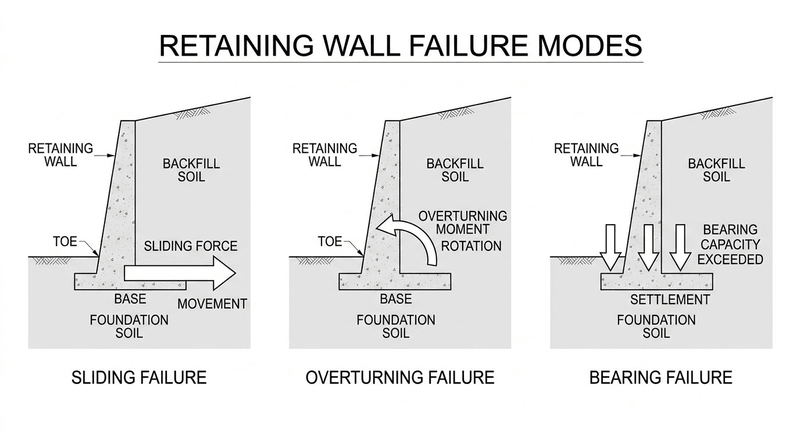
Understanding the three failure modes that every retaining wall must resist helps you evaluate any project critically — not just follow rules, but understand why the rules exist.
Sliding
The wall is pushed horizontally and shifts forward along its base. Resistance comes from wall weight multiplied by base friction.
Overturning
The wall rotates forward around its toe (the front-bottom edge). Resistance comes from wall weight multiplied by the distance from the weight to the toe.
Bearing Failure
The soil beneath the wall compresses under load and the wall sinks or tilts. This is a soil problem — and it’s why the foundation matters.
Base Width Rule
Most design guides specify base width = 2/3 of wall height as a conservative starting value. This ratio simultaneously addresses sliding, overturning, and bearing capacity. Skimping on base width compromises all three.
Batter
Gabion walls should lean slightly backward into the retained slope. A 6–10° batter (approximately 1 inch backward lean per foot of height) significantly improves overturning resistance. Stepped-face walls create batter automatically. Smooth-face walls require batter to be built in from the foundation up.
Height Limits
Well-designed gravity gabion walls can reach approximately 18 ft (5.5 m) without engineered reinforcement. With engineering and geo-anchors, up to 30 ft (9 m) is achievable. Typical residential and commercial projects fall in the 3–6 ft range.
⚠️ One thing worth double-checking before you build: The 18 ft and 30 ft height figures in this guide come from published manufacturer design guides — solid references, but they don’t account for your local building codes. Every city and county has its own rules, and some are stricter than others. Before you finalize your design, a quick call to your local building department will tell you exactly what’s allowed in your area. It’s a five-minute call that can save you a costly redesign.
Everything You Need — No Guesswork
Tools Checklist
- Shovel and/or mini excavator for excavation
- Digging bar (essential in rocky soil)
- Wheelbarrow for rock and fill transport
- 4-ft (1.2 m) spirit level and long straightedge board
- String line and batter boards for layout
- Pliers — two pairs (one to hold, one to twist)
- Tin snips or bolt cutters for mesh adjustments
- Work gloves (steel-toe recommended when handling rock)
- Hand tamper or plate compactor for compaction
- Angle grinder + zinc-rich cold galvanizing spray (for wire repairs)
- Plumber’s snake or pressure jetter (for annual drain maintenance)
Gabion Baskets
- Standard size: 2 m × 1 m × 1 m,3 m × 1 m × 1 m.
- Mesh: standard 6 cm × 8 cm, 8 cm × 10 cm, 10 cm × 12 cm openings. All rock must exceed mesh opening — minimum practical rock size is 4 inches.
- Wire: hot-dip galvanized (HDG) steel, minimum 2.2 mm, 2.5mm, 2.7mm, 3.0mm, 3.5mm. PVC coating adds 15–20 years of corrosion resistance in aggressive environments.
Rock Fill — Structural Requirements
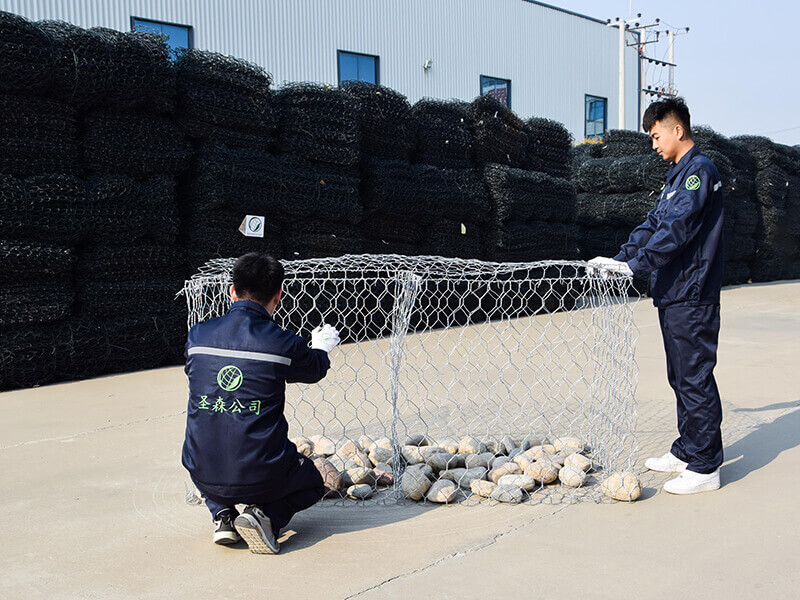
Rock fill is the structural mass of the wall. Specification violations here are the most common cause of gabion wall failure.
Hardness: Rock must not crumble under hand pressure. Test: strike two rocks together. A clear, ringing sound indicates durable rock. A dull thud or dust cloud means find different rock.
Shape: Angular stones interlock under load. Rounded river stones shift. Rounded stone is acceptable for the outer face layer only — never as structural fill.
Size: 4–8 inches. Every stone must be larger than the mesh opening.
Specific gravity: ≥ 2.5. Granite, basalt, and quartzite meet this readily. Limestone varies — verify against specs in freeze-thaw climates.
Quantity Calculation
Volume (m³) = Wall length × Wall height × Wall depth
Estimated tonnes = Volume × 1.7
Example: 10 m long × 1.5 m high × 0.5 m deep = 7.5 m³ ≈ 12.75 tonnes. Order 14–15 tonnes with waste factor.
4 Procurement Errors That Compromise Walls
- Buying the cheapest wire mesh. Wire gauge is structural. Verify 10-gauge (3.05 mm) minimum — not 12-gauge (2.64 mm).
- Mixing PVC-coated and bare galvanized wire. They corrode at different rates and create galvanic corrosion at contact points. Pick one type and use it consistently.
- Using soft limestone in freeze-thaw climates. Limestone absorbs water and spalls in freeze-thaw cycles. Hard basalt or granite is more reliable.
- Assuming “clean fill” means “structural rock.” River-washed clean fill is often rounded and too smooth to interlock. Specify angular, crushed quarry rock.
Gabion Specifications Quick Reference
| Parameter | Standard | Notes |
| Mesh type | Hexagonal double-twist | Standard 8×10 cm openings |
| Wire gauge | Minimum 10-gauge (3.05 mm) HDG | PVC coating optional |
| Basket size | 6 ft × 3 ft × 3 ft (2×1×1 m) | Half-depth (1.5 ft) for front face |
| Rock size | 4–8 inches | Must exceed mesh opening |
| Rock specific gravity | ≥ 2.5 | Granite, basalt, quartzite preferred |
| Rock shape | Angular | No rounded structural fill |
| Void ratio | 30–40% | Enables free drainage |
Foundation First — Where Most Walls Actually Fail
Foundation failures are the most common source of gabion wall problems — and the most preventable.
Step 1: Survey and Layout
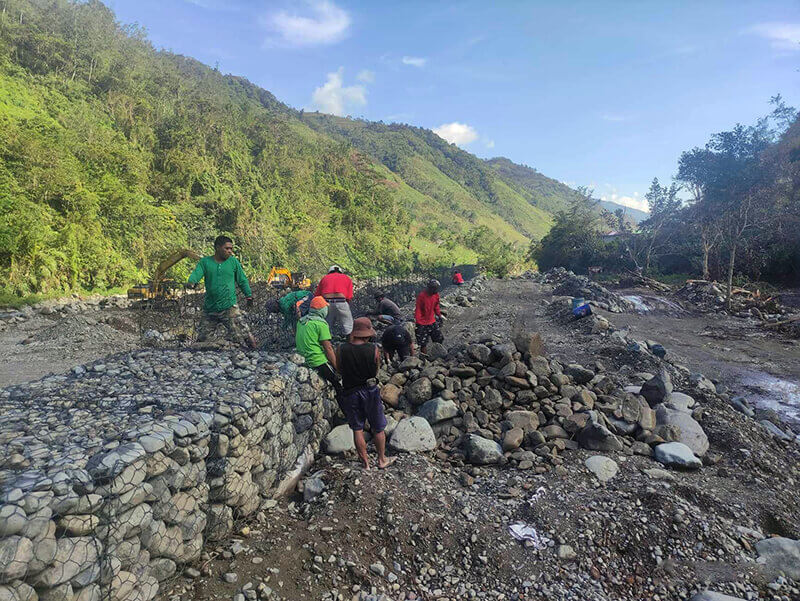
Set a string line along both the top and bottom edge of the planned wall footprint. Use batter boards at 6–8 ft intervals. Verify level along the entire length with a 4-ft spirit level on a straightedge board.
Step 2: Bearing Capacity — Field Test
Minimum bearing capacity required: 100 kPa (≈1,000 kg/m²).
Field test: dig a 12″ × 12″ pit to foundation depth. Place a rigid board in the pit and load it with approximately 100 lbs. If settlement is less than ¼ inch (6 mm), bearing capacity is likely adequate. If settlement exceeds this: remove soft material and replace with 6–18 inches of compacted Class II granular fill. Do not skip this step.
Soil Type Quick Assessment — The Feel and Ribbon Test
Squeeze a damp soil sample firmly in your hand, then attempt to form a ribbon between thumb and forefinger:
- Sandy/gravelly — won’t hold a shape, feels gritty. Excellent bearing.
- Silty — holds a shape, feels smooth when rubbed. Moderate bearing; consider replacement in high-load applications.
- Clay — holds a firm shape, can be smoothed to a shiny surface. Low permeability. Drainage design is especially critical.
- Organic soil (dark, fibrous, earthy smell) — unacceptable. Remove entirely.
Step 3: Foundation Trench Excavation
- Walls up to 3 ft: 6–12 inches below finished grade.
- Walls 3–6 ft: 12–18 inches below finished grade.
- Soft or variable soils: excavate to competent, unyielding material.
Step 4: Foundation Layer
Place compacted road base (1-inch crushed blue metal or basalt) in 2–4 inch lifts. Compact each lift to a firm, unyielding surface. Set 6–10° batter across the foundation surface — leaning gently toward the retained slope.
Assembling the Baskets — A Step That Saves Hours
Layout Before Connecting
Unfold all mesh panels on a flat surface. Lay out the full basket shape before connecting anything. Verify dimensions against the specification sheet. This step takes five minutes and prevents misalignment issues during filling.
Connection Method — Tie Wire
- Raise the side panels and middle partition to form the basket shape.
- Thread double-stranded binding wire through intersecting mesh holes along the edges.
- Twist the wire securely with a binding hook every 25 cm.
- Add internal cross-binding support wires to prevent the walls from bulging.
Proper basket assembly is the foundation of any sturdy retaining wall. For the exact technique on threading, twisting, and adding cross-supports, head over to our simple guide to tying gabion wire.

Three Assembly Rules That Matter
- Internal diaphragms must be perpendicular to the wall face. They are the structural stiffeners that prevent basket deformation under load.
- Stagger vertical seams between adjacent baskets. Aligned seams create a continuous structural weak plane across the wall.
- Install bracing ties (stay wires) for baskets over 3 ft in any dimension. Run diagonal corner wires from top to bottom of the basket, threading through mesh at top, middle, and bottom of each diaphragm. Pull snug — not tight. The wire needs flexibility to accommodate fill settlement.
High-Wall and Sloping-Site Detail
On walls taller than two courses (6 ft), or on sloping sites, add vertical steel support columns (2-inch galvanized steel posts) at intervals of every third basket. This is standard practice in engineered installations and meaningfully improves long-term stiffness.
Filling the Baskets — The One Step Most People Get Wrong
Work in 12-Inch Horizontal Layers
After each layer:
- Hand-pack rocks — do not dump from height. Dumping causes segregation: fine material settles to the bottom, large rocks accumulate at the top.
- Compress by foot or with a hand tamper to seat rocks into interlock.
- Check for voids and fill with smaller rock pieces. Never use soil or fine material to fill gaps.
- For walls taller than one course: install bracing wires for every layer.
Face Rock Placement
Pre-sort the flattest, most visually consistent rocks and stage them separately before filling. Place these with their flattest face toward the exterior as you work across each layer — before the basket is full, not after. Interior fill can be less uniform, as long as size and hardness requirements are met.
Preventing Bulge
Bulge (outward deformation of the basket face) is the most common aesthetic and structural complaint in gabion walls. Prevention: install bracing wires every 12 inches of fill height. Do not overfill — the lid must close without forcing mesh outward. Use temporary spacers (short pieces of rebar or wood) during filling to maintain basket width and prevent face bowing. Lid closing for standard 3-ft baskets is a two-person job.
How to Stack It — Stepped vs. Smooth Face
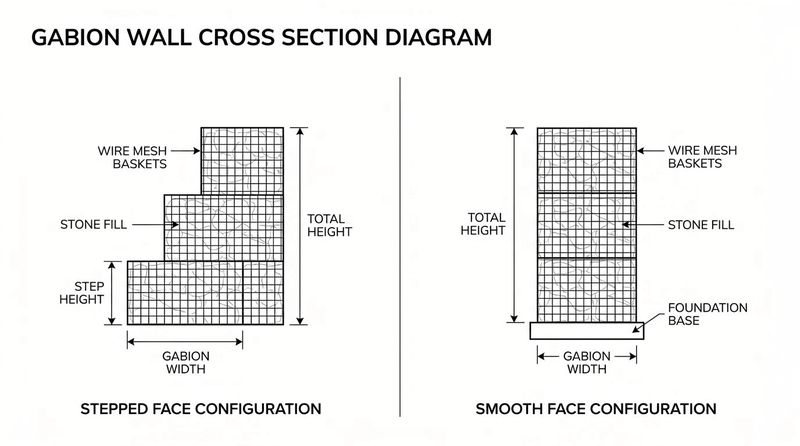
Stepped Face
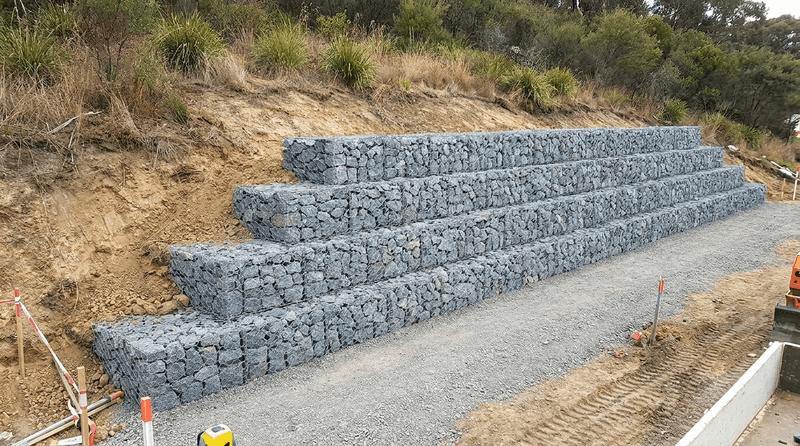
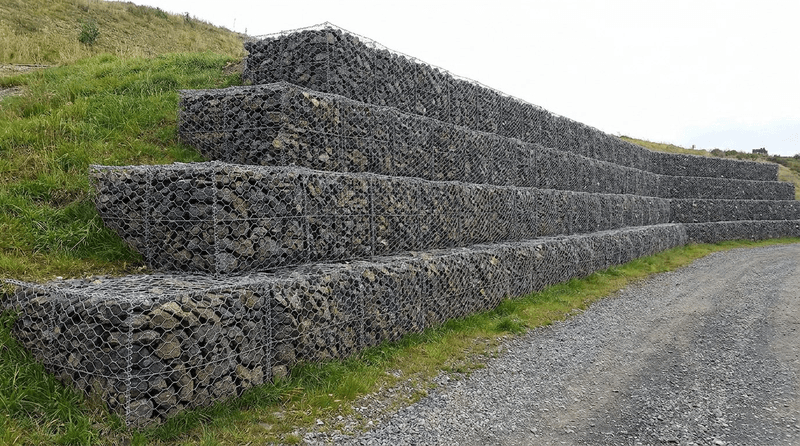
Each course steps back 1–1.5 ft (30–45 cm) from the course below. This creates batter automatically and is the more stable configuration. Each course also serves as a working platform for the next.
Step-back rule: for every 3 ft of vertical rise, step the front face back a minimum of 1–1.5 ft. A 6-ft wall should step back at least 2–3 ft from bottom to top.
Smooth Face
The wall face is vertical or near-vertical. Requires deliberate batter (6–10°) built in from the foundation up. Without batter, a smooth-face wall has significantly reduced overturning resistance.
Bottom Row Deepening
As wall height increases, consider deepening the bottom row of baskets. Rule: for every additional 3 ft of wall height above 3 ft, increase the bottom row basket depth by half a standard basket depth. This distributes the load over a wider bearing area.
Seam Staggering
When stacking courses, offset vertical seams between adjacent baskets by at least one basket width (typically 3 ft). Aligned seams are a structural weak plane.
Sloping Terrain
The wall should step down in both elevation and plan. Match the step height to the basket height (3 ft per course). A single course should not span more than 12 inches of grade change without a step.
Drainage — the No.1 Reason Gabion Walls Fail
Most gabion wall failures are caused not by structural defects in the wall itself, but by inadequate management of water in the soil behind it. Drainage in a gabion wall is straightforward to execute correctly — and easy to skip under time or budget pressure. Don’t skip it.
Why it matters: Water always accumulates behind a retaining wall. Without an escape route, it builds hydrostatic pressure against the wall face — deflecting, cracking, or collapsing even a structurally perfect wall over time. In freeze-thaw climates, trapped water expands during freezing and destroys the structure from within.
Gabion stone fill is permeable (water passes through it freely) — but this only addresses water inside the wall. Water in the retained soil behind the wall requires its own drainage system.
The 3-Part Drainage System
Every well-drained gabion wall implements all three of these elements:
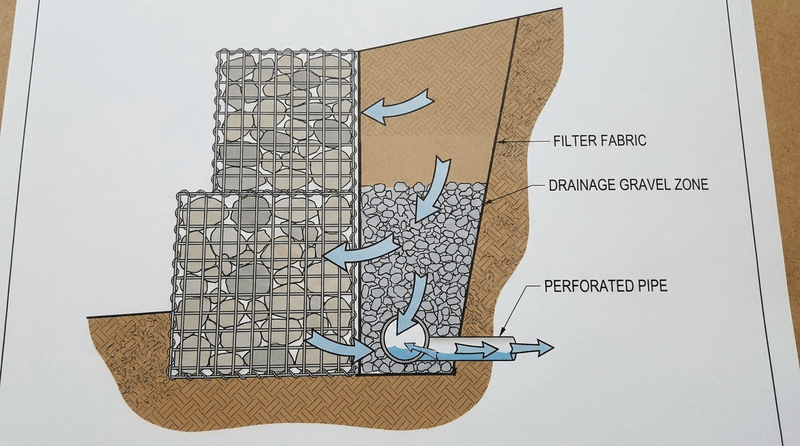
- Geotextile filter fabric — placed between the gabion wall and the retained soil, it allows water through while preventing soil particles from migrating into the gabion voids (which causes settlement and stone loss over time).
- Drainage gravel zone — clean angular drainage aggregate (¾–1½ inch, no fines) placed in a zone directly behind the filter fabric, extending from the top of the retained soil to within 12 inches of the wall base. Creates a preferential path for water to travel downward.
- Weeping jet drain pipes — 4-inch minimum perforated HDPE or PVC pipe behind the wall (wrapped in filter sock), sloping at minimum 1% grade toward exit points through the gabion face at 8–10 ft intervals.
Filter Fabric Installation
Run fabric from the top of the retained soil to the base of the wall. Overlap fabric layers by a minimum of 12 inches. Extend fabric up over the top of the backfilled area so soil cannot wash down into the gabion structure.
Filter Fabric Selection by Soil Type
- Sandy, free-draining soil: Lightweight non-woven fabric (3–5 oz/yd²).
- Silty or mixed soils: Medium weight (5–8 oz/yd²) with cross-plane permeability rating higher than the soil.
- Clayey soil: Heavier non-woven fabric (8–12 oz/yd²) or a geocomposite drainage mesh behind the fabric.
Backfilling Done Right
Approved Backfill Materials
Coarse sand, sandy gravel, sandy clay (less than 15% fines), crushed stone.
Gabion walls have a wider acceptable backfill range than reinforced soil walls — the wall’s stability is not dependent on friction between the soil and the gabion baskets.
Rejected Materials
Organic soil, high-plasticity clay, material with more than 30% fines, frozen material.
Compaction Standard
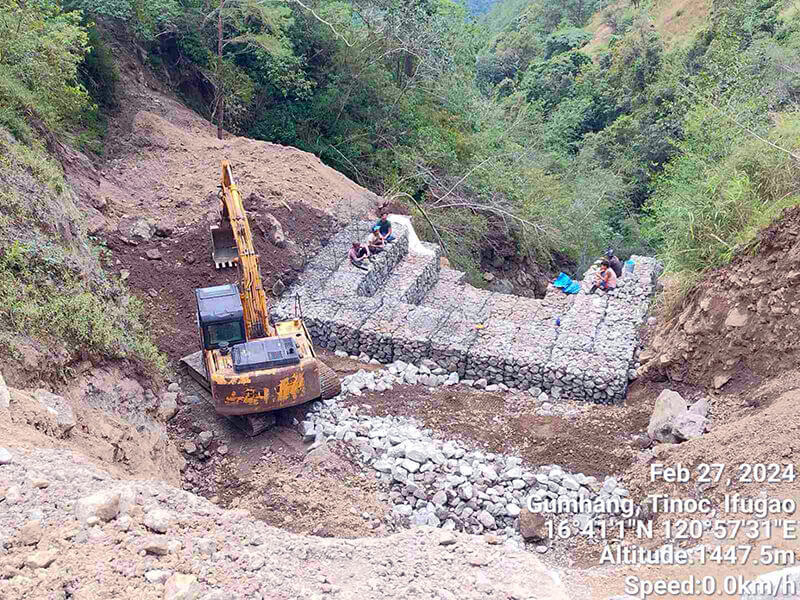
95% Standard Proctor in lifts no greater than 9 inches. With a plate compactor, this is achievable. By hand: use 4-inch loose lifts, apply 4–6 passes with a hand tamper per lift, keep soil damp (not soaking wet), and verify by stepping firmly — deep impressions indicate more compaction is needed.
⚠️ One practical note on compaction: The 95% Standard Proctor standard mentioned here is what professional engineers target for walls near structures or property lines — it’s the right benchmark for most projects. For small, low-height walls well away from anything critical, some builders get away with less. But if your wall is holding back any meaningful load or sitting close to a building, stick with 95%. It’s not hard to achieve with a plate compactor — and it’s much easier to do right the first time than to fix later.
Scour Apron
Where surface water runoff will cross the ground in front of the wall toe, install a scour apron (gabion mattress or reno mattress) extending outward from the wall toe. Minimum depth: 9–12 inches. Extend to twice the anticipated maximum scour depth. Fill with 3–6 inch stone for reno mattresses, or 4–8 inch stone for standard gabion baskets.
When Things Go Wrong — and How to Stop It
Bulging
Outward deformation of the basket face. Almost always caused by rushing the fill step or skipping bracing wires. Prevention: 12-inch layer method, bracing wires every layer, no overfilling.
Wire Corrosion
Primary long-term durability concern. Expected lifespan: HDG wire in normal soil conditions, 50–100 years. In mildly corrosive soil: 25–50 years. PVC coating adds 15–20 years in aggressive environments. Inspect annually. White rust (surface oxidation) is cosmetic — treat with cold galvanizing compound. Red rust indicates deeper corrosion — replace the affected basket or panel.
⚠️ A note on wire lifespan: The 50–100 year figures in this guide are based on published industry data — they’re realistic for normal soil conditions, but your site may not be normal. Acidic soils, high chloride content, poor drainage, and coastal environments all accelerate corrosion. If you’re building near the coast, in industrial soil, or anywhere drainage is uncertain, ask a materials engineer to recommend the right wire coating for your conditions. It’s a small step that can add decades to your wall’s life.
Stone Loss Through Mesh
Stones emerging from the wall face indicate filter fabric failure: wrong fabric type for the soil, inadequate seam overlap, or fabric torn during backfilling and not repaired. Prevention is far easier than repair.
Foundation Scour
Water flowing along the front of the wall toe erodes the foundation soil, causing the wall to sink at the front edge. Prevention: install a scour apron and ensure drain pipes exit away from the wall toe.

Backfill Washout
Fines migrating through the filter fabric, or backfill eroding behind the wall, leads to settlement and structural loss. Prevention: verify backfill material before use, install the correct filter fabric, keep drain exits clear and functional.
Keep It Standing for 50+ Years
Gabion walls are inspectable and repairable — unlike concrete, which often fails without warning. An annual inspection catches most developing problems while they remain cheap to address.
Annual Inspection Checklist (Spring or Late Autumn)
Walk the full wall face and check:
- Bulging or deformation of basket faces?
- Wire breaks, corrosion, or missing spiral connectors?
- All weep pipes clear and flowing freely?
- Vegetation growing through the wall? (Cut — do not pull. Pulling tears mesh.)
- Erosion or scour in front of the wall toe?
- Settlement or sinkholes in backfill behind the wall?
Field Inspection Checklist (Annual)
- Bulging or face deformation?
- Broken or missing wire connections?
- Corrosion on any wire surface?
- Weep pipes blocked or dry (blocked)?
- Vegetation growing through mesh?
- Scour or erosion in front of wall toe?
- Sinkholes or settlement in backfill?
- Filter fabric visible through any gaps?
Drainage Maintenance
Jet drain pipes clear annually with a plumber’s snake or pressure washer. Late autumn in freeze-thaw climates — clear pipes won’t trap water that will expand during freezing.
Wire Repair
Cut out damaged sections and splice in new wire with minimum 4 turns of helical spiral at each connection. Treat surface corrosion with zinc-rich cold galvanizing compound. For deep corrosion or broken structural mesh wires: replace the affected basket or panel.
What It Actually Costs — Materials and Labor
Key Cost Variables
- Rock is typically the largest single expense. Locally quarried rock is dramatically cheaper than specialty decorative stone. Get quotes from at least two suppliers.
- Wall height drives cost roughly linearly. More height = more baskets, more rock, more labor.
- Site access significantly affects total cost. If machinery cannot reach the site, every tonne of rock moves by hand.
- Soil conditions may add cost. Soft soil requiring excavation and replacement is a known variable — budget for it rather than omitting it.
Cost Example — 10 m × 1.5 m Wall
- Wall volume: 7.5 m³
- Rock needed: 12.75 tonnes (order 14–15 tonnes with waste factor)
- Rock cost at $60/tonne:$840–$900
- Gabion baskets (≈7 standard + half-depth face units): $600-$1,200
- Filter fabric, drainage gravel, drain pipe: $200-$400
- Estimated total materials: $1,640-$2,500 (delivery, tools, disposal not included)
- Contractor-installed for the same wall: approximately $5,000-$12,000 in the US, depending on site conditions and labor rates.
⚠️ Budgeting tip: The cost ranges in this guide reflect general US market conditions as of 2026 — they’re a solid starting point, but your local market will have the final say. Rock prices in particular swing wildly by region: locally quarried stone can be half the cost of the same material shipped from out of state. Get at least two supplier quotes before committing to a budget. And don’t forget delivery — on large orders, haulage can rival the cost of the rock itself.
Answers to the Questions Every Builder Asks
Do gabion walls need a concrete foundation?
No — not like reinforced concrete walls. A compacted granular base (2–4 inches of road base on competent soil) is sufficient for walls up to approximately 6 ft. Soft soils may require a deeper or wider granular mat — but a concrete footing is not required.

What kind of rocks should I use?
Hard, angular stone, 4–8 inches, specific gravity at least 2.5. Crushed granite, basalt, and quartzite are excellent. Avoid soft limestone in freeze-thaw climates. Never use rounded river stones as structural fill — acceptable for the face layer only.
Do gabion walls need drainage?
Always. Gabion stone permeability only addresses water inside the wall. Water in the soil behind the wall requires filter fabric, a drainage gravel zone, and weep pipes. Without these, hydrostatic pressure will accumulate.
How high can I build without an engineer?
Approximately 3 ft (0.9 m) in typical soils is a straightforward project for experienced contractors. Most US jurisdictions require permits and engineering for walls 4 ft (1.2 m) or taller. Always check local codes before proceeding.
Can I use recycled concrete as fill?
For non-structural, low-height decorative walls under 3 ft, recycled concrete meeting size and hardness requirements can work. For any structural gravity wall, virgin angular crushed stone is strongly preferred. Recycled concrete has variable strength, may contain rebar or contaminants, and sulfate content can accelerate wire corrosion.
Do I need a building permit?
In most US municipalities, yes — for walls 4 ft (1.2 m) or taller measured from foundation to top. Some jurisdictions require permits for walls as short as 2–3 ft near property lines or structures. Check with your local building department before procurement.
How long will a gabion wall last?
A well-built gabion wall with HDG wire in normal conditions: 30–50 years. PVC-coated wire extends this to 40–60 years in moderate environments. The stone fill lasts essentially forever. Wire corrosion is the limiting factor — and proper drainage is the single most important factor in long-term durability.
Conclusion
A well-built gravity gabion retaining wall is one of the most durable, low-maintenance structures you can add to a property. The materials last indefinitely — stone doesn’t rot, steel wire in proper conditions lasts 30–50 years, and the wall’s permeable design handles water pressure better than any rigid concrete alternative.
The critical variables are three: foundation preparation, drainage engineering, and rock fill specification. Get these right and the wall will hold for decades with minimal maintenance. Get any one of them wrong and the consequences are costly — often irreversible.
Before you buy materials, know your soil, know your wall height, and know whether your project needs engineering sign-off. Before you start filling, verify every basket’s bracing is in place. Before you backfill, confirm the drainage system is complete and functional.
The wall you build today will either pay you back through decades of service — or cost you through repairs, replacement, or worse. This guide gives you everything you need to make sure it’s the former.
You May Also Interested