Gabion Retaining Wall Cost: The Complete 2026 Pricing Guide
Last Updated: April 21, 2026
- Project scale — smaller projects carry higher per-unit costs due to fixed mobilization fees
- Wall height — walls over 1.5m require formal engineering, adding 15–25%
- Soil and slope conditions — rock and expansive clay add 20–150% to excavation costs
- Stone fill source — quarry distance adds $1.50–$3.00/tonne per 50km; can shift total cost by 15–25%
- Coating specification — GalFan costs 35–50% more than HDG but extends service life from 25–50 to 75–100+ years
What Does a Gabion Retaining Wall Actually Cost in 2026?
Every contractor has heard this story: a client receives three quotes for the same project, all of which look reasonable. One comes in $18,000 over budget after site work begins. The reason is consistent — four mandatory cost items that were never included in the initial bid.
This guide is built differently. Every price cited is traceable to a verifiable source. Every cost item is named. By the end, you will be able to build a gabion wall budget from scratch — and identify exactly what any quote is missing.
One definition: throughout this guide, “gabion wall cost” means fully installed cost (materials, labor, and standard site preparation) unless stated otherwise. Supply-only pricing is covered separately in the sourcing section.

Market Prices: What the Industry Is Actually Paying
| Market | Installed Cost | Source |
| United States | $10–$40 / sq ft | HomeGuide, December 2025 |
| United Kingdom | £240 / m² | Checkatrade, March 2025 |
| Canada | $25–$65 / sq ft | Project Landscaping Ontario, March 2026 |
| Australia | AUD $150–$450 / m² | Retaining Wall HQ, Gold Coast, February 2023 |
| Germany / Netherlands | EUR 150–450 / m² | Directional estimate |
The $10–$20/sq ft US range describes projects with good site conditions and local stone supply. The $30–$40 end captures walls with unfavorable soil, significant excavation, or engineered designs.
Most US residential projects land between $20–$35/sq ft. UK data is anchored to Checkatrade’s 24,051 verified reviews. Australia data is specific to Southeast Queensland — Sydney and Melbourne typically run 15–25% higher.
The Four Cost Items Most Frequently Missing from Bids
- Site excavation and subgrade preparation. Required for virtually every project. Typical cost: $8–$20 / sq ft depending on soil conditions.
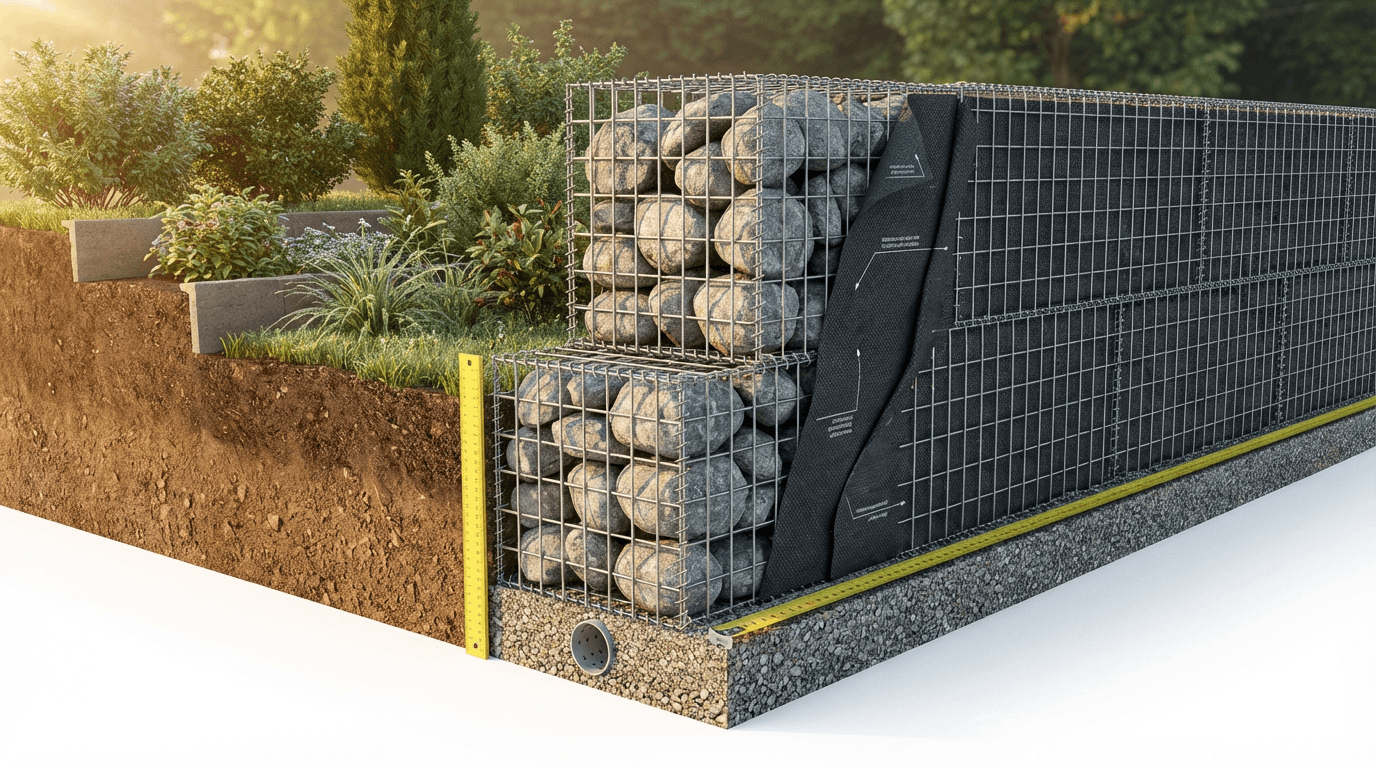
- Drainage system. Geotextile fabric, perforated drain pipe, and in clay soils, a granular drainage layer. Skipping this is the leading cause of gabion wall failure. Typical cost: $5–$12 / sq ft.
- Stone fill delivery and mechanical placement. Quarry delivery is separate from stone material cost. Mechanical placement adds $3–$8 / sq ft on top of material.
- Equipment mobilization. A crane or excavator is required for walls over 0.5m. Typical: $500–$2,000 per site visit.
A properly structured quote should list each of these separately. If yours says “lump sum” without breaking these out, request a revised line-item breakdown before signing.
Why Scale Changes the Unit Price
The per-square-foot cost of a 15m² garden wall and a 300m² commercial wall are not comparable — not because of contractor margin, but because of mathematics. Mobilization fees, equipment minimums, and stone delivery charges are fixed. On a 15m² project, they represent $133–$200/m² of wall area. On a 300m² project, the same fixed costs represent $6–$8/m².
Use residential-scale benchmarks for projects under 50m². Use commercial-scale benchmarks for projects above 50m².
Gabion Wall Cost by Project Type
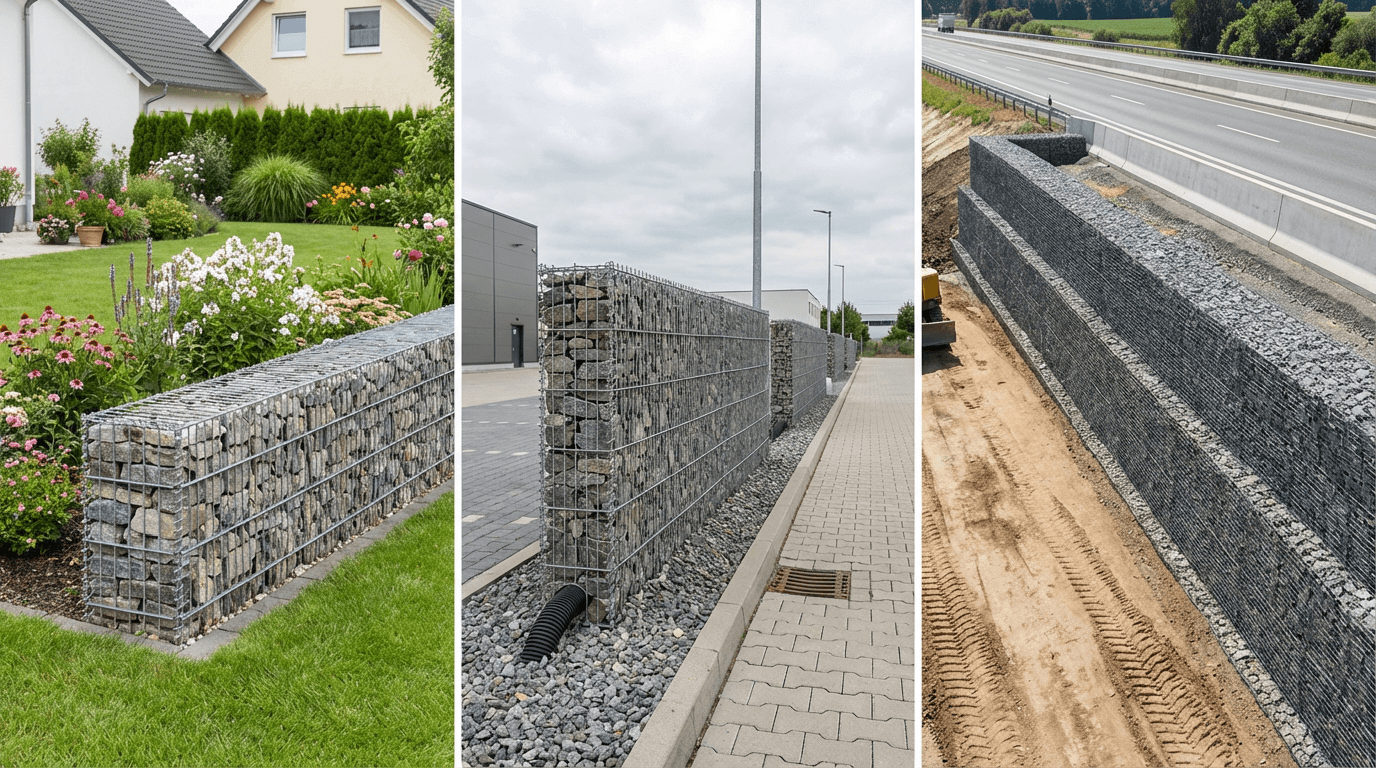
Price ranges vary significantly by project scale. Three categories cover the majority of real-world specifications.
Residential Projects — Under 50m²
US installed cost: $10–$40 / sq ft. Most projects land $20–$35 / sq ft depending on site conditions.
The reason for the wide range: a 1m wall on stable flat ground with a nearby quarry is a fundamentally different project from a 2m terraced wall on clay with rock below the surface. Stone fill cost deserves specific attention: on a small residential project, the stone fill often costs more than the gabion baskets themselves. Budget $800–$2,400 for stone on a 20m² wall depending on quarry distance.
Commercial and Municipal Projects — 50–500m²
US installed cost: $18–$50 / sq ft. Volume pricing improves unit economics but introduces new cost items absent from residential projects.
- Engineering design drawings are required for walls over 1.5m in most jurisdictions. Budget $1,500–$8,000.
- Municipal projects frequently require third-party inspection ($800–$3,000) and sometimes a performance bond equal to 5–10% of contract value.
- Traffic management plans add $500–$2,500 when the site interfaces with public right-of-ways.
Infrastructure and Government Projects — 500m²+
US installed cost: $12–$35 / sq ft Estimate; spec-dependent. Infrastructure projects introduce ASTM A975 certification requirements, documented stone fill gradation testing, and formal quality assurance protocols.
If a project specification references GalFan and your quote is based on standard hot-dip galvanized, you are either overbidding or about to supply the wrong product. Confirm coating specification before submitting.
The Full Cost Breakdown
1. Gabion Baskets and Mesh

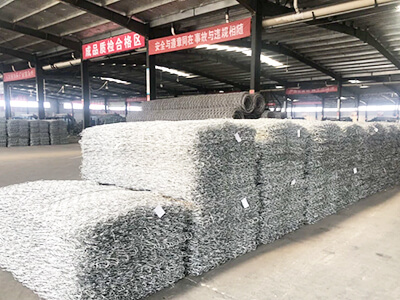
Basket price is determined by four independent variables. Quoting without specifying all four is comparing undefined products. Wire diameter: 2.0mm is DIY and decorative only. 2.7mm is the industry standard for commercial applications. 3.0mm is specified for heavy commercial, coastal, and infrastructure applications. FOB China prices range $1.2–$6.0/m² depending on diameter and specification.

Coating type: Standard hot-dip galvanized (HDG, 350g/m², ASTM A123) is the baseline — 25–50 year service life. GalFan (zinc-5%Al-MM, ASTM A856/A856M) is specified for 75–100 year service life — 35–50% cost premium. PVC-coated over HDG base is used in coastal and UV-intensive environments — 40–60% cost premium over HDG.
Coating weight matters more than the coating name. A product described as “galvanized” without a zinc coating weight specification (g/m²) may perform anywhere from 100g/m² to 350g/m². Request the actual tested coating weight before comparing prices.
2. Stone Fill
Stone fill is the most underestimate cost item in residential gabion projects. Material costs $30–$100/ton depending on rock type and source. Delivery costs scale with distance from quarry. Rule of thumb: 1m³ of gabion wall requires approximately 1.65–1.8 tonnes of stone fill. A 20m² wall at 0.5m depth needs roughly 17 tonnes. At $50/ton, stone fill alone is $850 at the project site.
3. Site Preparation and Excavation
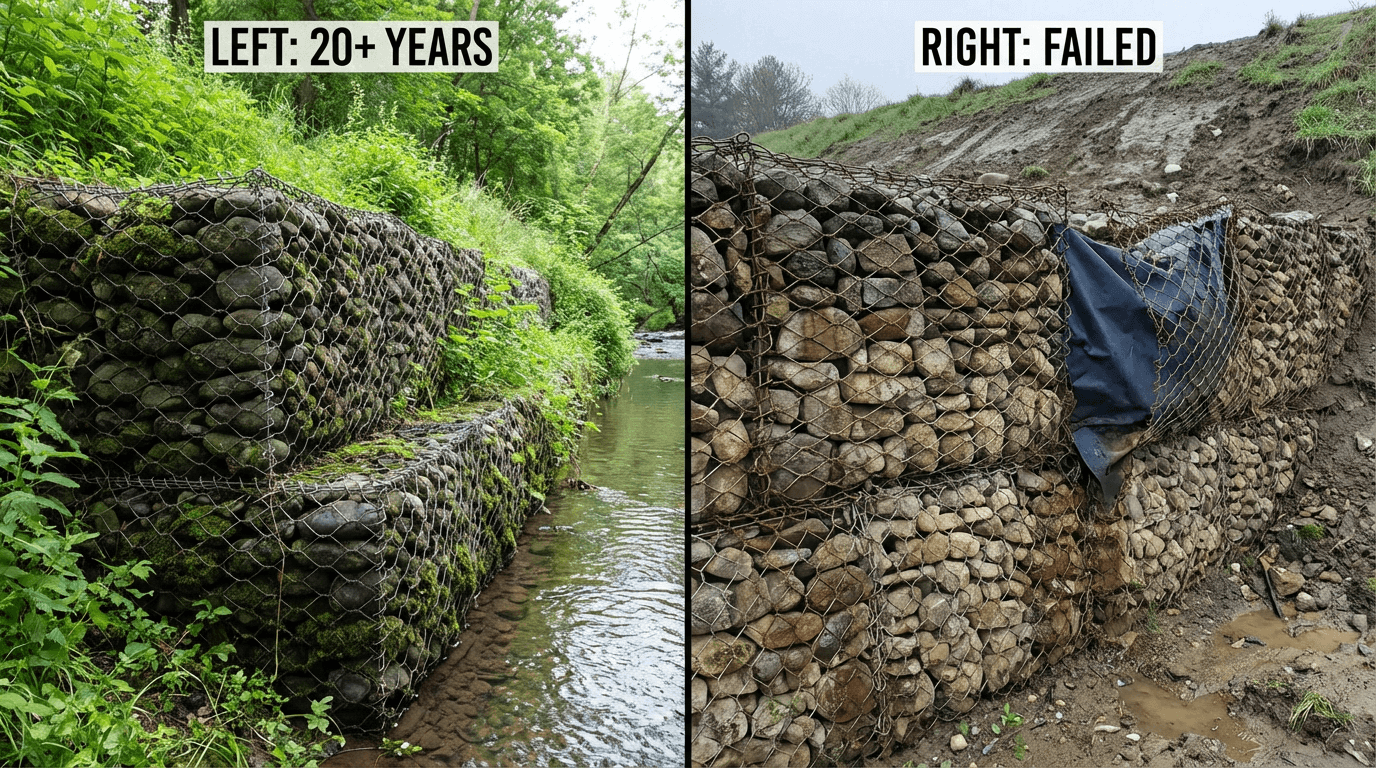
Pricing on best-case assumptions when the site is unknown is how projects exceed budget. Sandy and gravelly soils: baseline. Clay soils: $8–$18 / sq ft additional. Expansive clay: $15–$30 / sq ft additional — may require full excavation and granular replacement. Rock: $25–$60 / sq ft additional — requires breaker or blasting.
4. Drainage System
A gabion wall without geotextile filter fabric will experience internal erosion over time as fine soil particles migrate through the stone fill. The result is progressive loss of retained material, eventual bulging, and structural failure.
Required components: non-woven geotextile filter fabric (minimum 200g/m²); perforated drainage pipe (100–150mm diameter) daylighting at each end; in clay soils, a granular drainage layer minimum 300mm wide behind the gabion face. Total drainage system cost: $15–$40 / linear meter, supply and installation.
5–7. Hardware, Labor, and Equipment
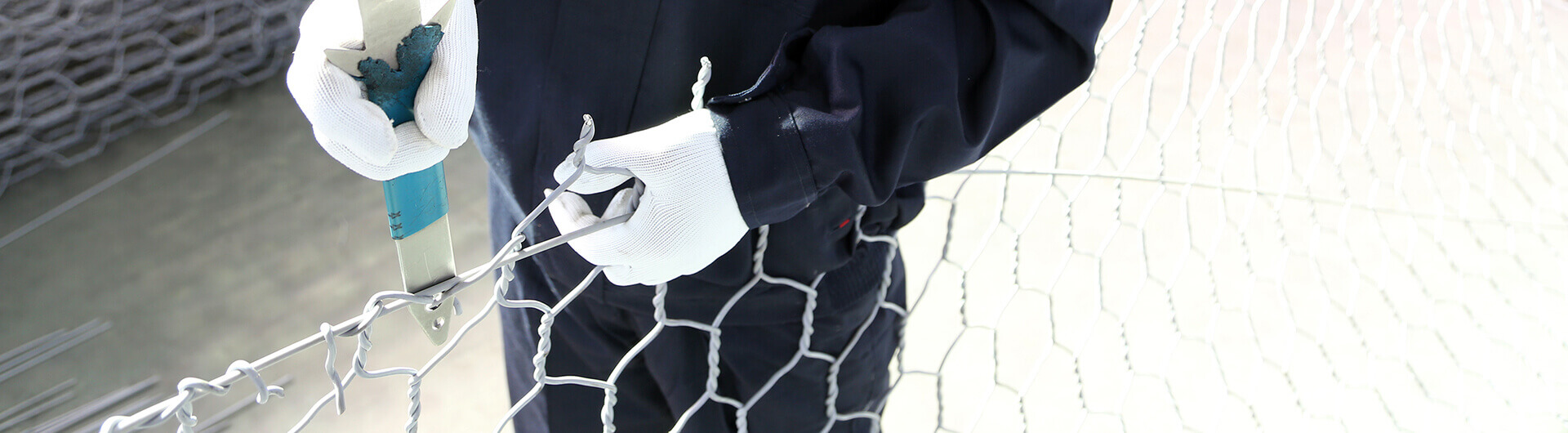
Hardware (lacing wire, spiral binders, stiffener rods) is a structural component. Confirm whether they are included in the basket unit price or quoted separately — omitted hardware typically represents 5–15% of material cost as a hidden surcharge.
Labor represents 30–50% of total installed cost on residential projects. US rates: $30–$45/hr (South, Midwest); $50–$80/hr (Northeast, West Coast). A two-person crew installs approximately 8–15m² per day depending on wall height and site conditions.
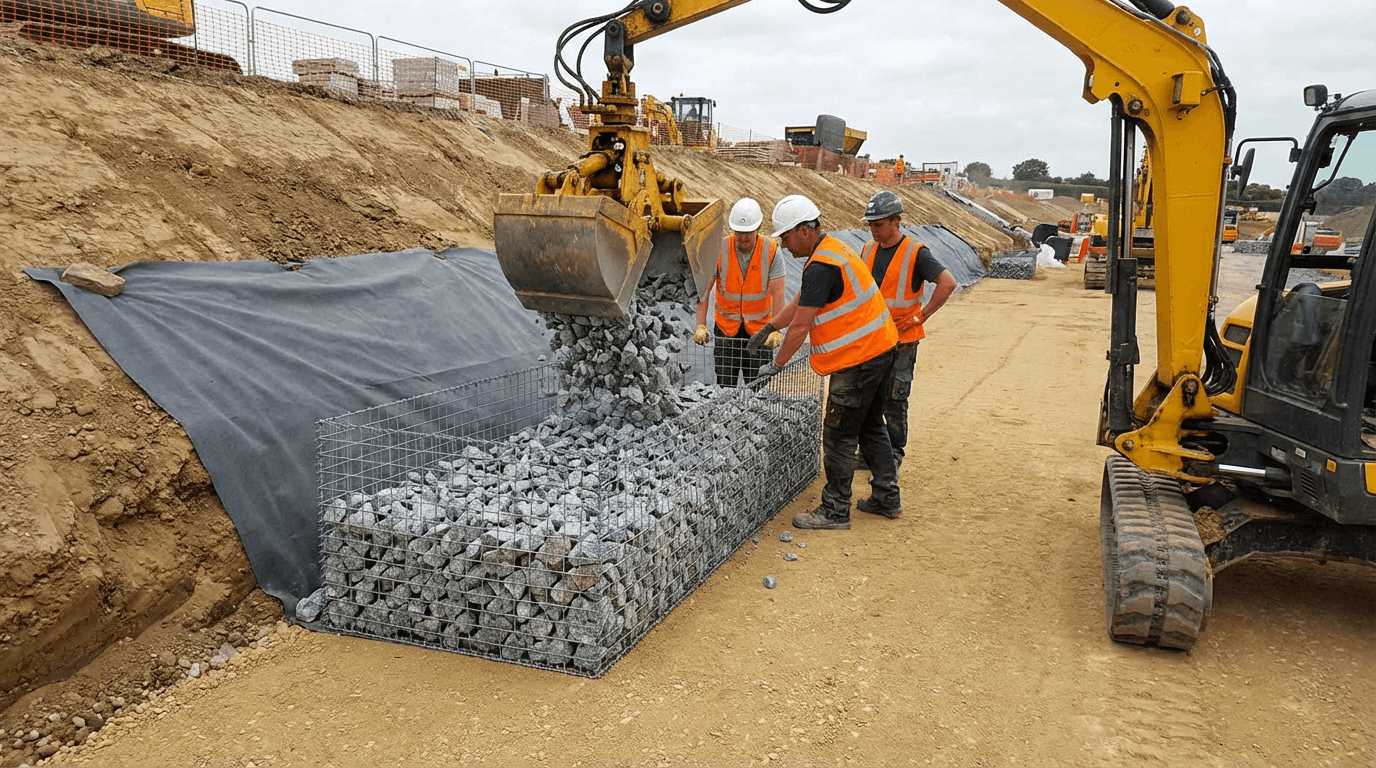
Equipment is a fixed cost. Typical daily rental in US markets: mini excavator $150–$350/day; skid steer $120–$280/day; crane or telehandler $400–$900/day; plate compactor $50–$120/day. Most rental companies apply a half-day minimum charge.
Total Cost of Ownership: 10, 25, and 50 Years
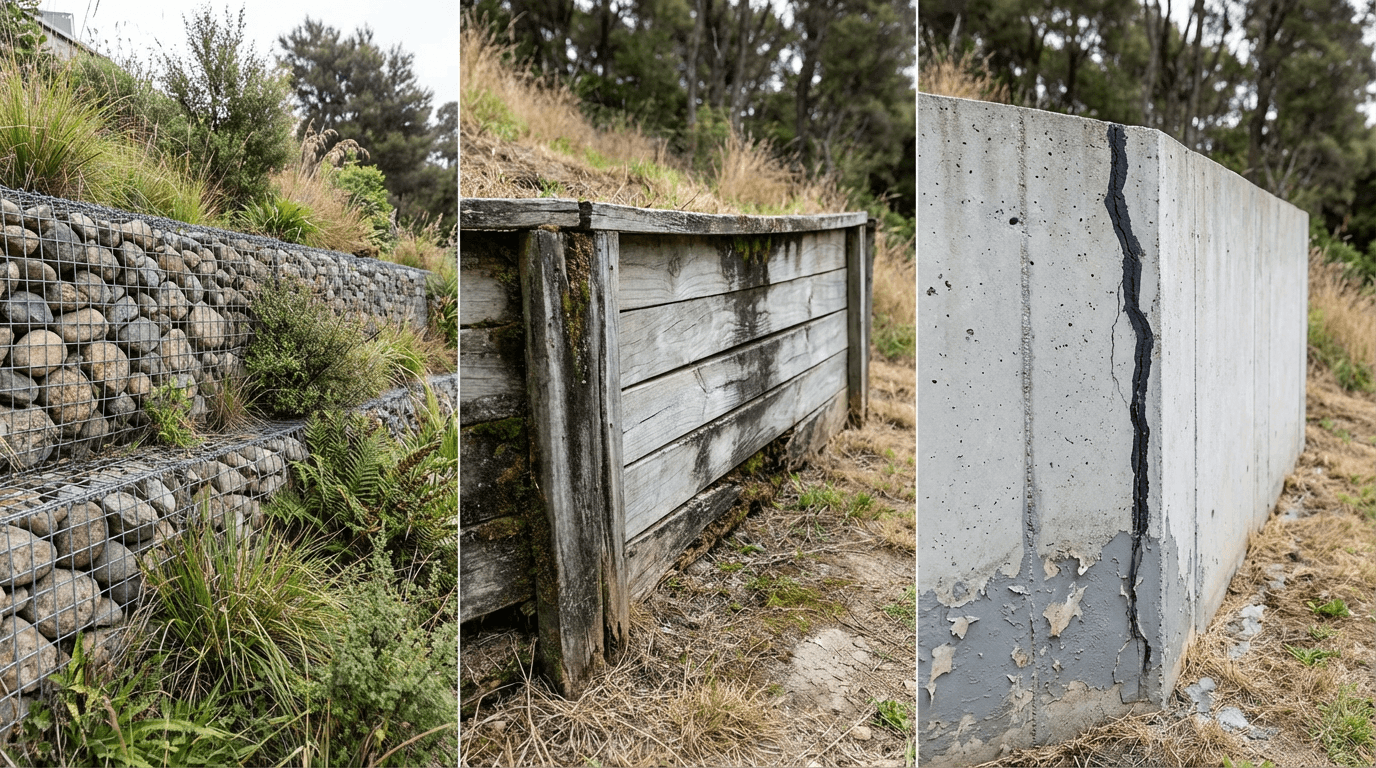
The comparison that matters is not initial cost. It is total cost of ownership across the design life of the structure.
The three cost components for any retaining wall are: initial construction cost, ongoing maintenance cost, and end-of-life replacement cost. Most comparison articles address only the first. This systematically disadvantages gabion walls, which have moderate initial costs but near-zero maintenance and replacement costs over 50 years.
Residential project, 20m², 50-year TCO:
- Gabion wall: $8,400 initial + $1,600 maintenance = ~$10,000 total over 50 years
- Treated timber: $5,400 initial + $28,200 in three replacements = ~$33,600 total over 50 years
- Poured concrete: $9,600 initial + $3,300 maintenance = ~$12,900 total over 50 years
- Concrete block: $7,200 initial + $1,600 maintenance = ~$8,800 total over 50 years — the lowest TCO in this scenario
Commercial project, 200m², 50-year TCO:
- Gabion wall: ~$59,500 total over 50 years
- MSE wall: ~$49,000 total over 50 years — lowest at this scale
- Poured concrete: ~$104,000 total over 50 years
Infrastructure project, 2,000m², 75-year TCO (GalFan specified):
- Gabion wall: ~$200,000 total over 75 years
- Poured concrete: ~$340,000 total over 75 years
GalFan-coated gabion achieves the lowest TCO for 75+ year infrastructure applications where drainage performance and settlement accommodation are valued.
Checklist: What to Ask Before You Buy

Before getting a quote:
- Define total wall surface area including the buried base course (300–600mm below grade)
- Obtain or commission a geotechnical site assessment
- Confirm whether engineering design is required for your wall height
- Get stone fill delivered pricing from three local quarries
- Specify the design life and corresponding coating requirement (HDG vs GalFan vs PVC)
When comparing supplier quotes:
- Confirm actual wire diameter (mm), tested zinc coating weight (g/m²), relevant product standard (ASTM A975, EN 10223-8:2013), mesh aperture test data, hardware inclusion in unit price, production lead time, and payment terms
When evaluating installation contractors:
- Verify prior gabion installation experience with a site visit
- Confirm base course preparation methodology (compacted granular leveling course to 98% Proctor density)
- Confirm who installs the drainage system and geotextile
Before approving a budget:
- Confirm mobilization fees, stone fill delivery and placement, excavation quantity and disposal costs, geotextile and drainage, engineering fees, permit fees, and payment schedule
- Include a 10–15% contingency for all budget categories
Common Questions
Is gabion cheaper than poured concrete?
Does gabion need a concrete footing?

Can I install a gabion wall myself?
What stone size is required?
How long do gabion walls last?
You May Also Interested